Double-entry accounting
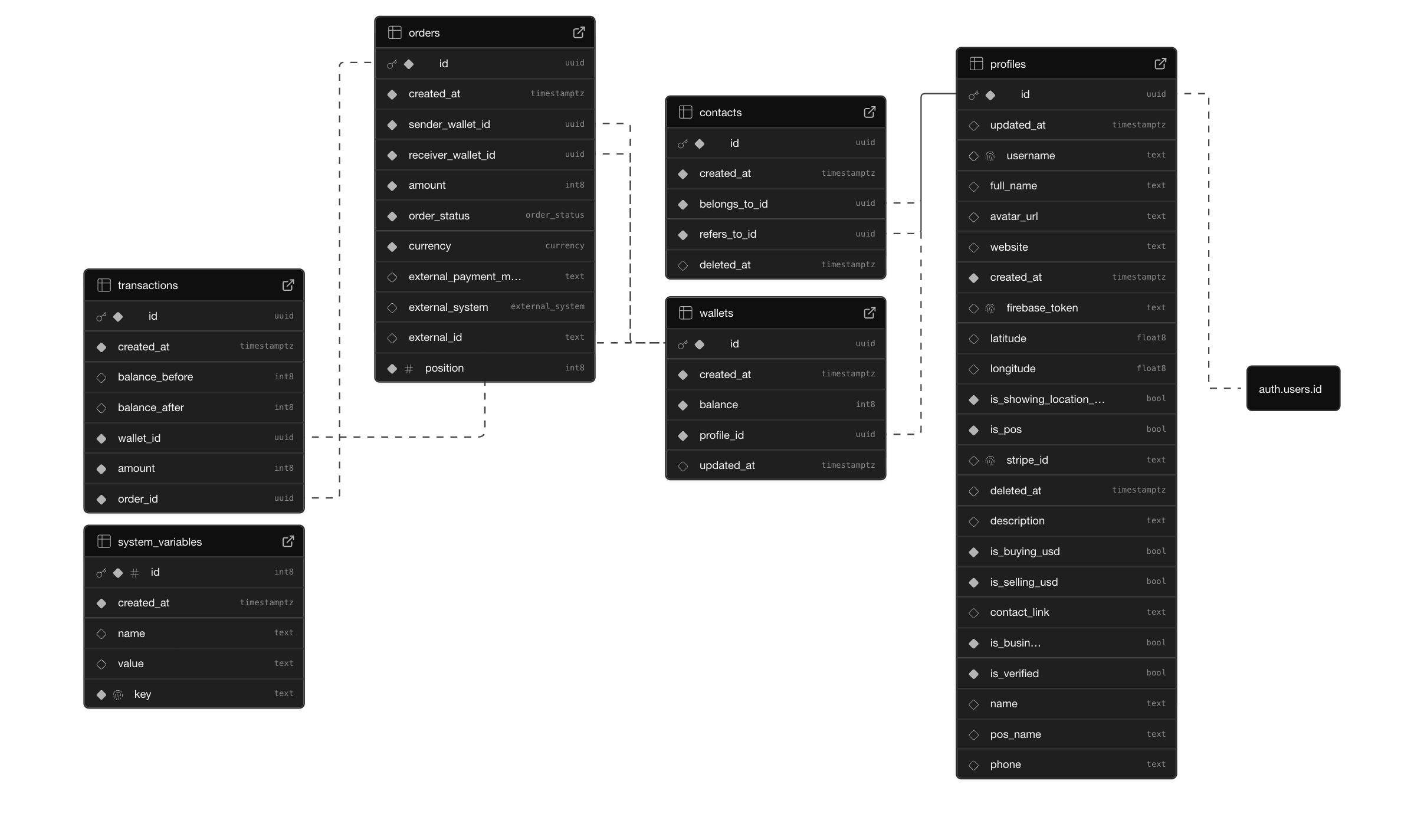
Yapago relies on a double-entry ledger that looks like the image below. The entire schema can be found here.
Use of cents
Floating-point numbers (like 0.1 + 0.2) are notorious for causing precision errors due to how they are represented in binary precision. By using integers (cents), wee avoid the "lost penny" problem where $19.999998$ might be rounded incorrectly. Every currency calculation remains deterministic across different programming languages and database engines. This is the industry standard for payment processors like Stripe and Adyen.
Double-Entry Transactions
The core principle here is that money is never "created" or "destroyed" in the system; it only moves from one place to another. More specifically, a few points are worth mentioning:
-
The "net zero" rule: For every "debit" (+), there is a corresponding "credit" (-). If you sum the entire transactions table, the result should ideally be zero (or match your system's initial liquidity).
-
Audit trail: This creates an immutable history. If a user’s balance looks wrong, you can replay every + and - transaction to see exactly where the discrepancy occurred.
-
Wallet isolation. Because each transaction is a row, calculating a wallet balance is a simple SUM() operation on that specific wallet_id.
-
For every order, two transactions are created, one in positive and the other in negative. In this way, reconciliation is always possible. Also the transactions table makes is easy to fetch data about a a single wallet.
Low cardinality enums to represent order status
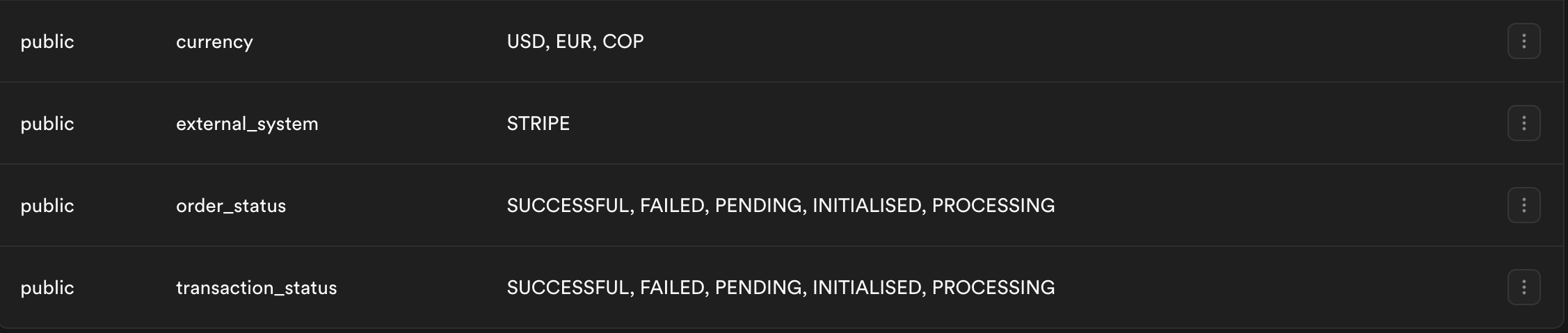
Using a database ENUM for order status is a performance and integrity choice.
-
Data integrity. It prevents "garbage" data (e.g., someone accidentally entering a status like "PENDINGG") from entering the database.
-
Storage efficiency. Enums are stored internally as integers, which is much faster for the database to index and search than long strings of text.
-
Predictability. Since the workflow (Pending -> Processing -> Success/Fail) is stable, the overhead of managing a separate "Statuses" table is unnecessary.
Atomic order locking: the queue pattern
The queue pattern. It ensures that exactly one worker handles one order at a time.
-
Race condition prevention. Without this, two different background workers might pick up the same pending order at the same microsecond and process it twice.
-
The query below ensures that no new order starts processing if there is already an order currently in the PROCESSING state, maintaining a strict sequential flow.
update orders
set order_status = 'PROCESSING'
where orders.id in (
  select a.id
  from orders as a
  where a.order_status = 'PENDING'
  order by a.position asc
  limit 1
) and not exists (
  select *
  from orders as b
  where b.order_status = 'PROCESSING'
) returning orders.id
Schema denormalization
In a "pure" database, we would always calculate balance on the fly. However, as the transactions table grows to millions of rows, SUM() becomes slow.
-
Read vs. Write Trade-off: You are choosing to make "Writes" slightly more complex (running a function after an order) to make "Reads" (checking a balance) instant.
-
Simplified Queries: Instead of joining three tables every time a user wants to see their dashboard, you can simply query wallets.balance.
-
Sync Strategy: The function you mentioned acts as a "Trigger-like" mechanism to ensure the denormalized balance stays in sync with the source of truth (the transactions).
select sum(transactions.amount)
from transactions
left join orders on orders.id = transactions.order_id
where wallet_id = calculate_balance_by_wallet_id.wallet_id
and orders.order_status = 'SUCCESSFUL'